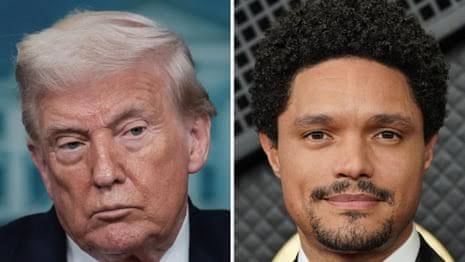
South African comedian Trevor Noah has once again found himself at the centre of political controversy in the United States, this time after a sharp joke aimed at President Donald Trump during the Grammy Awards. The comment, which referenced Trump’s alleged links to convicted sex offender Jeffrey Epstein, sparked immediate backlash from the former president and his supporters, with some even calling for Noah’s deportation.
Noah, who hosted the Grammys for the sixth and final time, used his opening monologue to deliver a pointed jab at Trump. The joke quickly went viral, drawing both applause and outrage across social media. Trump responded on his Truth Social platform, accusing the comedian of making “false and defamatory” statements and warning that Noah should prepare himself financially for a possible lawsuit.
While Trump stopped short of explicitly calling for Noah’s deportation, some of his supporters have revived that idea online, questioning the comedian’s right to live and work in the United States. This has led many South Africans and international fans to wonder whether Noah could realistically face removal from the country over his remarks.
The short answer is no. Trevor Noah is not an undocumented immigrant or a temporary visitor to the US. He moved from South Africa to the United States in 2011 to expand his career in comedy and television. His big break came in 2015, when he took over as host of The Daily Show, a role he held until 2022, becoming one of the most recognisable political satirists in the world.
According to widely reported information, Noah became a naturalised US citizen in 2020. This means he enjoys the same constitutional protections as Americans who are citizens by birth. Under the US Constitution, particularly the 14th Amendment, naturalised citizens cannot simply be deported at the whim of a sitting president or government official.

In practical terms, this means that even if Trump were serious about wanting Noah out of the country, he would not have the legal authority to make that happen. Deportation laws apply to non-citizens, such as visa holders or undocumented immigrants—not to citizens.
There is, however, one narrow and highly unusual exception: denaturalisation. This can occur if the US government can prove that a person obtained citizenship unlawfully. Examples include fraud, deliberate misrepresentation during the application process, concealing serious criminal activity, or involvement in certain subversive acts. Even in such cases, denaturalisation is a complex legal process that requires strong evidence and court proceedings. It is not something that can be triggered by a political joke or a public disagreement with a president.
For now, the real risk to Noah appears to be legal rather than immigration-related. Trump’s threat to sue suggests a potential defamation battle, although such cases are notoriously difficult to win in the US, especially when they involve public figures and comedic or satirical commentary.
Noah continues to split his time between the United States and South Africa, maintaining a global career in stand-up, producing, and hosting. Despite the online noise and political outrage, his status as a US citizen means he is firmly protected from deportation. In short, while the war of words may continue, Trevor Noah is not going anywhere.
About the Author