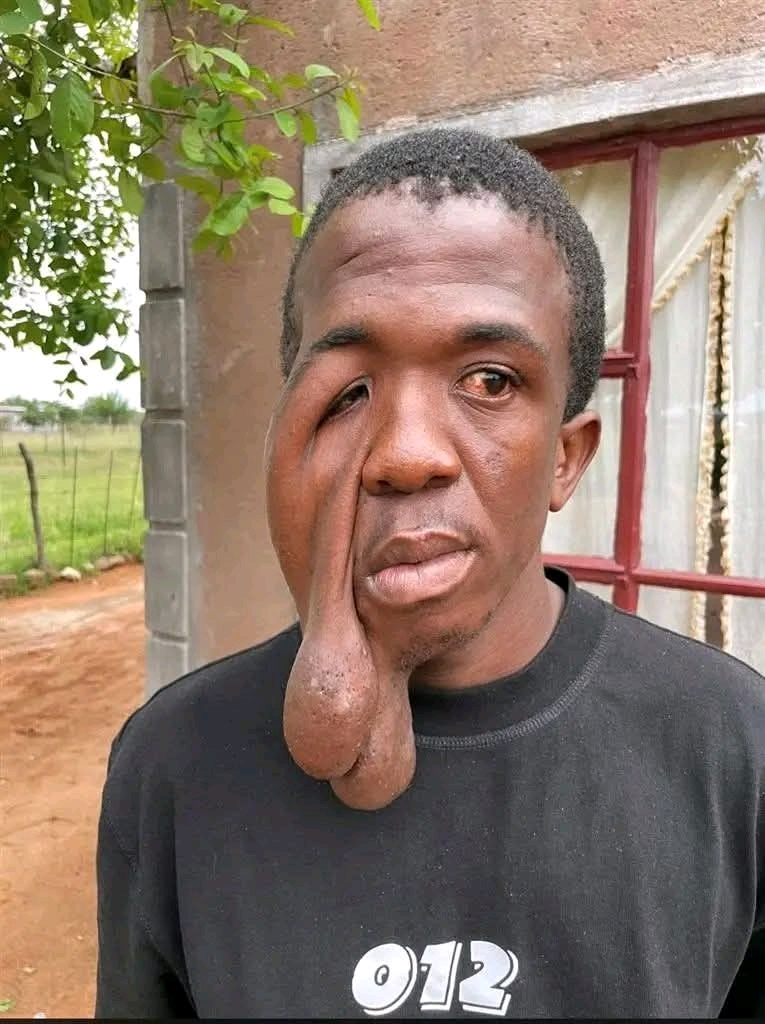
A 24-year-old man from Limpopo has made a heartfelt appeal for medical assistance after living with a large and painful facial keloid for nearly two decades. Tshwarelo Makopo, from Khoreng Village in Zebediela, says the condition has not only affected his physical health but has also taken a heavy emotional and social toll on his life and his family.
Tshwarelo’s ordeal began when he was just five years old. What initially appeared to be a small pimple on the side of his face gradually developed into a massive keloid as he grew older. Over the years, the abnormal scar tissue continued to expand, becoming more noticeable and increasingly difficult to live with.
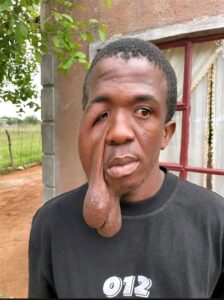
“I was still in primary school when it started,” Tshwarelo explained. “It began as a small pimple and it just kept growing as I grew. I didn’t understand what was happening, and neither did anyone else.”
Now in his twenties, Tshwarelo says he desperately needs surgical intervention but has been unable to receive the help he requires. His story recently gained widespread attention on social media after he was visited by Dr Ephraim Kgoete from the Khayalami Foundation, a non-profit organisation that assists patients in need of specialised medical and surgical care.
“Right now, I need assistance to get an operation,” Tshwarelo said, adding that he has exhausted almost all available options within the public healthcare system.
According to Tshwarelo, he has spent years moving between hospitals in search of help. He first sought treatment at Magatle Hospital before being transferred to Pietersburg Hospital. From there, he was referred to Dr George Mukhari Hospital, where he was admitted for five weeks. Despite this, no surgery was performed.
“The doctors told me the operation was risky,” he said. “They warned that it could cause heavy bleeding or that the keloid might grow back again. After that, nothing happened.” Tshwarelo says his last attempt to seek hospital assistance was in 2016, after which he lost hope in the system.
His mother, Mme Makopo, said the family has never stopped searching for help but has felt completely helpless. “We never gave up hope,” she said. “The problem is that after going to so many hospitals and getting no help, we didn’t know where else to turn.”
Dr Kgoete has since spoken out about Tshwarelo’s condition, describing its impact as deeply distressing. He confirmed that the Khayalami Foundation has launched a donation drive and has formally appealed to the Limpopo Department of Health to intervene.
“The consequences of this situation are multi-dimensional,” Dr Kgoete said. “The patient has endured years of mockery, stigma and discrimination within his community. His mother has also been emotionally affected by watching her child suffer for so long.”
The foundation has called on members of the public, private stakeholders and health authorities to stand in solidarity with Tshwarelo and assist in funding and facilitating the surgery he urgently needs. At the time of publication, the Limpopo Department of Health had not yet responded to calls for intervention.
For Tshwarelo and his family, hope now rests in the hands of compassionate individuals and organisations willing to help end a painful chapter that has defined most of his life.
About the Author