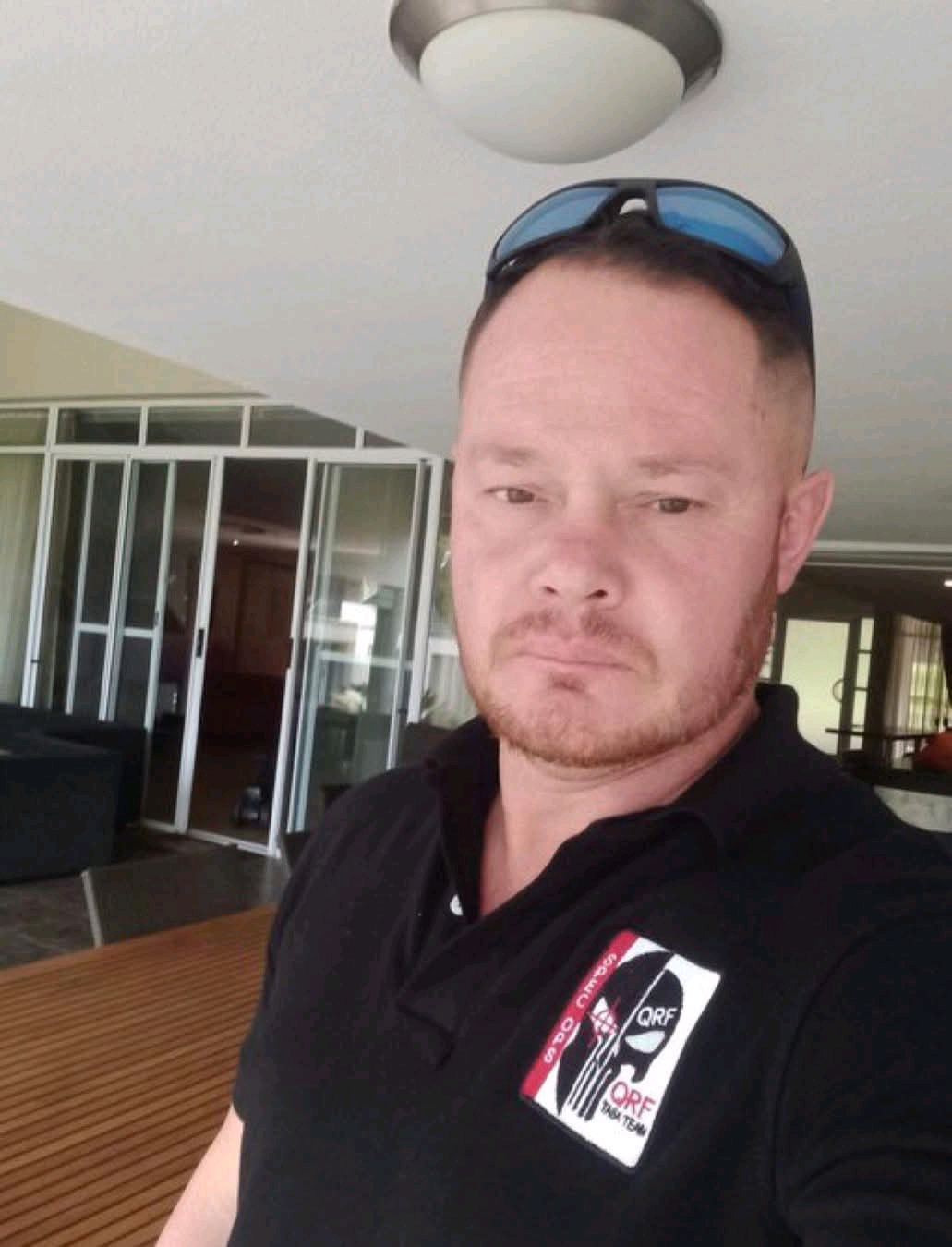
Marius van der Merwe, also known by his commission codename “Witness D”, was a former member of the Ekurhuleni Metropolitan Police Department (EMPD) who later founded a private security firm. He was recently murdered outside his home — a killing that has sent shockwaves across South Africa.
Background & Career
Van der Merwe spent over a decade working with the EMPD on the East Rand, assigned to tactical-response and crime-prevention units that dealt with high-risk tasks such as stock theft, armed robberies, and illegal mining operations.
In the mid-2010s he left EMPD and in 2018 established his own private security company, QRF Task Team, based in Brakpan. The firm focused on rapid-response security, stock recovery, high-risk arrests, and tackling illegal mining — often working in conjunction with law enforcement agencies.
Testimony at the Madlanga Commission
On 18–19 November 2025, van der Merwe testified anonymously before the Madlanga Commission, under the name “Witness D”.
He revealed shocking allegations against senior EMPD officers, including:
- That in April 2022 an EMPD operation resulted in the death of a robbery suspect who was tortured — suffocated with a plastic bag until he died.
- That the then-acting EMPD deputy chief Julius Mkhwanazi ordered van der Merwe to remove the body in his personal vehicle and dispose of it — allegedly dumping it in a mineshaft or dam.
- That there was widespread extortion and “recovery-fee” schemes within the EMPD’s tactical units, especially tied to livestock recovery for farmers.
- That he possessed additional evidence implicating senior EMPD members with illegal mining syndicates — evidence he had intended to present at a later hearing.
The testimony made Van der Merwe a prominent whistle-blower, exposing grave allegations of abuse, corruption and cover-ups within the metro police.
Assassination: Murder Outside His Home
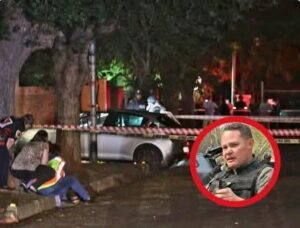
On the evening of Friday, 5 December 2025, van der Merwe was shot dead outside his home in Brenthurst, Brakpan, in full view of his family. He had just arrived with his wife and children when gunmen — reportedly driving a white Nissan NP200 pickup with a canopy — opened fire. He was hit multiple times and pronounced dead at the scene. No one stole anything from him; his phone, firearm and wallet remained untouched.
Investigations revealed that an automatic rifle — an AK-47 — was used in the killing. A full manhunt was launched, with forensic teams, crime-intelligence units and specialists involved.
Shockingly, van der Merwe was not under any formal witness protection programme at the time; although protection had been offered, he reportedly declined, believing his own security background and company would suffice.
Aftermath: Outrage, Mourning and Calls for Accountability
The murder has provoked widespread condemnation across political and civil society. The Democratic Alliance (DA) denounced the killing as an “attack on the very foundations of accountability and justice,” calling for urgent reforms to safeguard whistle-blowers and witnesses in high-stakes investigations.
The official leadership has also responded: Cyril Ramaphosa described the killing as a direct assault on integrity and justice, and pledged that the government would “redouble efforts” to protect those who come forward with truth, including participants in the Madlanga Commission.
Meanwhile, the commission’s chairperson, Mbuyiseli Madlanga, is set to meet with Fannie Masemola, the national police commissioner, to discuss strengthened witness-safety measures.
For many, van der Merwe’s assassination is a chilling warning: exposing corruption and abuse, even when done under official commission, can come at the gravest price. His death underscores the peril faced by those who dare to speak out — and has renewed urgent calls for structural protections to safeguard truth-tellers in South Africa.
About the Author