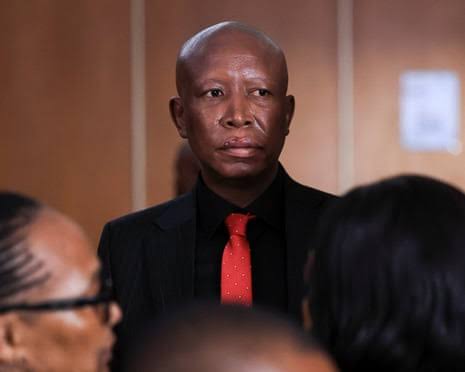
Economic Freedom Fighters (EFF) leader Julius Malema has urged South Africans to shift their attention away from the ongoing controversy surrounding foreign-owned spaza shops and instead focus on what he describes as the country’s bigger economic challenge – ownership and control of strategic sectors such as mining.
Malema made the remarks during the funeral service of uMkhonto weSizwe (MK) Party parliamentary deputy chief whip Mzikayise Ntshingila on Sunday. Addressing mourners, he argued that public frustration over foreign nationals operating township businesses has overshadowed deeper issues related to economic transformation and ownership of South Africa’s wealth.
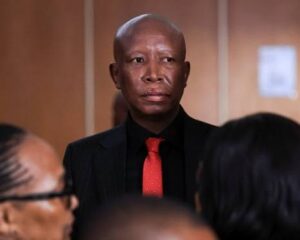
The EFF leader questioned why there have been calls for action against foreign-owned spaza shops while there has been little mobilisation around the ownership of mines, which he believes play a far greater role in determining the country’s economic future.
According to Malema, South Africans should be directing their energy towards reclaiming strategic industries rather than targeting small business operators. He suggested that the mining sector remains one of the most important economic assets in the country and should be at the centre of discussions about transformation and economic justice.
He argued that many of the companies benefiting from South Africa’s mineral wealth are not owned by ordinary citizens and that the country’s resources should be managed in a way that benefits the people more directly. Malema reiterated the EFF’s long-standing position that strategic means of production should be placed in the hands of what he called the “rightful owners”.
The outspoken politician also criticised what he sees as misplaced priorities in public debates surrounding migration and xenophobia. He suggested that international powers have largely remained silent on tensions involving foreign nationals because such disputes do not threaten broader economic interests.
Malema claimed that South Africans are being distracted by internal conflicts while larger structural issues continue to affect the country’s economy. He warned that divisions among ordinary people could prevent meaningful progress towards economic transformation.
The EFF president further emphasised the need to address historical inequalities created during colonialism and apartheid. He argued that economic policies should prioritise African workers and women, whom he described as the groups most severely affected by decades of systemic exclusion and disadvantage.
While advocating for targeted measures to uplift historically marginalised communities, Malema stressed that such policies should not be interpreted as hostility towards other racial or ethnic groups. He maintained that the goal is to correct historical injustices rather than promote division.
He acknowledged the struggles faced by all South Africans but argued that different communities experienced apartheid differently, resulting in varying levels of economic hardship that continue to be felt today.
Malema also called for unity among African people and warned against divisions within the working class. He said solidarity is essential if South Africans hope to achieve meaningful economic change and overcome persistent inequality.
Reflecting on the passing of Ntshingila, Malema said the late MK Party leader played an important role in fostering cooperation within Parliament. He added that Ntshingila’s death should serve as an opportunity for political leaders and citizens alike to unite around common goals and continue the struggle for economic transformation and social justice in South Africa.
About the Author