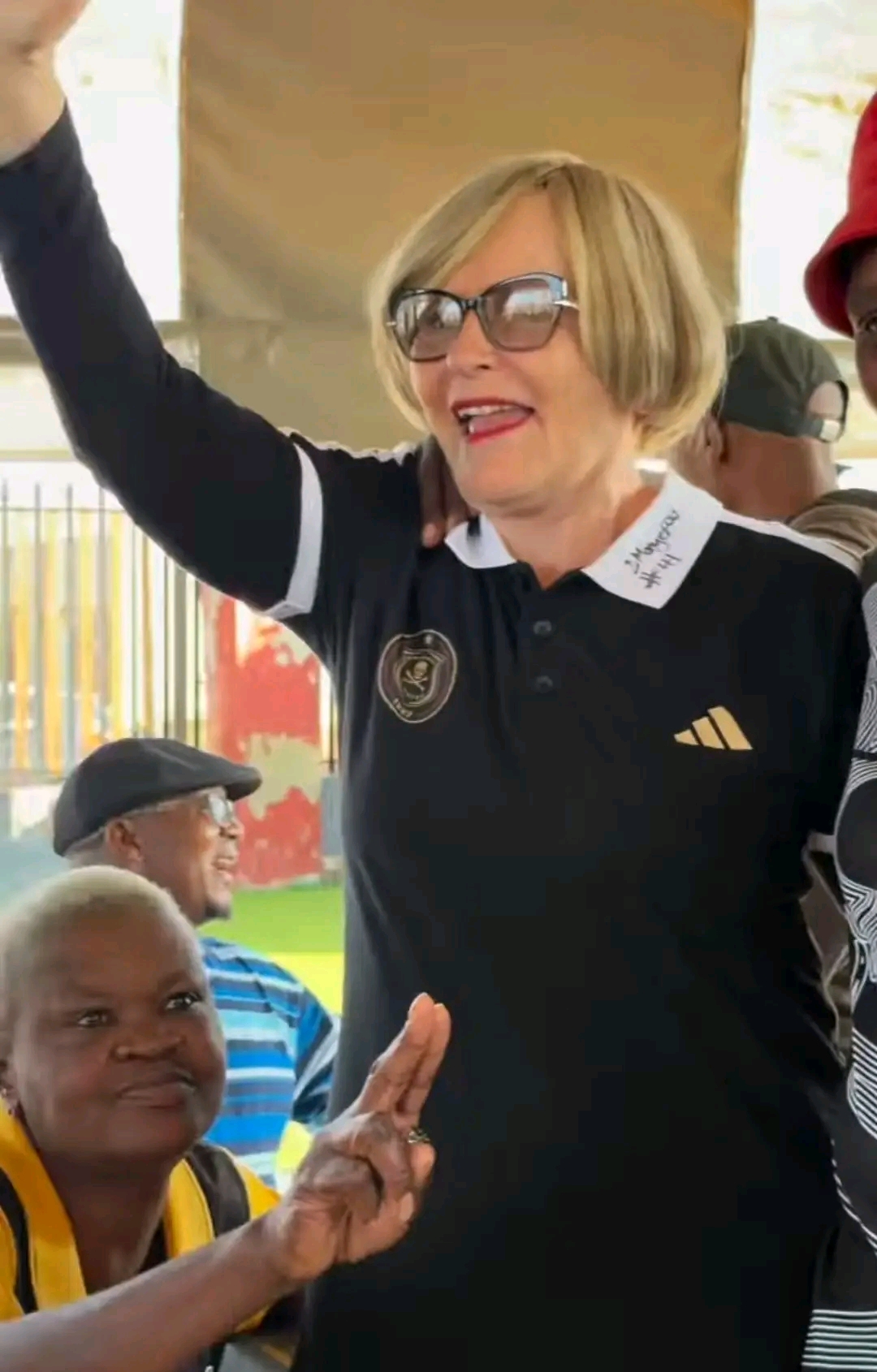
A political storm has erupted ahead of one of South Africa’s biggest football events, with ANC Secretary-General Fikile Mbalula accusing DA veteran Helen Zille of pretending to support Orlando Pirates for political mileage.
The controversy unfolded in the build-up to the highly anticipated Soweto Derby between Orlando Pirates and Kaizer Chiefs, played on Sunday, 26 April. The derby, one of the most fiercely contested fixtures in South African football, drew not only sports fans but also unexpected political attention.

Helen Zille, 75, recently made headlines after publicly expressing her enthusiasm for Orlando Pirates. She shared posts on social media celebrating the upcoming derby and even went as far as purchasing the club’s latest jersey. In addition, Zille attended a team-related event where she interacted with players and supporters, further showcasing her apparent allegiance to the Buccaneers.
During the event, she was also presented with a vintage Orlando Pirates jersey signed by members of the squad that famously won the African Cup of Champions Clubs in 1995 — a historic achievement in South African football. Zille described her connection to the club as long-standing, despite facing skepticism from critics.

However, her actions quickly drew sharp criticism from Mbalula, who took to social media to question her authenticity. He accused Zille of exploiting the club’s popularity to appeal to black voters, describing her behavior as “pathetic” and “patronising.” According to Mbalula, Zille had never previously shown support for the team, and her sudden enthusiasm raised doubts about her intentions.
The criticism did not stop there. Several prominent political figures and public personalities echoed similar sentiments. Gauteng Premier Panyaza Lesufi, EFF leader Julius Malema, ActionSA’s Michael Beaumont, and media personality Ntsiki Mazwai all voiced their doubts, accusing Zille of using football as a campaign strategy rather than expressing genuine fandom.
Despite the backlash, the debate sparked widespread engagement online. Mbalula’s comments alone attracted over 100,000 views and hundreds of responses, with many South Africans divided on the issue. While some agreed with his criticism, others questioned whether political leaders should be focusing on such matters.
One social media user, supporting Zille’s potential mayoral ambitions in Johannesburg, criticized Mbalula’s priorities. The user pointed out ongoing service delivery challenges in the city, including water and electricity outages, and argued that these issues deserved more urgent attention than Zille’s football preferences.
The incident highlights the growing intersection between politics and popular culture in South Africa, where even football allegiances can become politically charged. As the country approaches key political contests, public figures are increasingly scrutinized for their actions — both on and off the campaign trail.
Whether Zille’s support for Orlando Pirates is genuine or strategic remains a matter of public debate. What is clear, however, is that the passion surrounding South African football continues to extend far beyond the pitch, influencing conversations in unexpected spaces, including the political arena.
About the Author